
Slipping, slipping backwards sliding into a place where no one can go nothing touches you everything touches you walk, climb crawl out up towards fresh air light and love. KEHN
A Song for Lysl
Prologue: I wrote this goofy story a while ago. This past Sunday, I decided to read a version of it at the Napa Valley Writers’ Open Mic. On Monday, 8-year old Brooklyn asked me what story I read. I paraphrased the tale for her.
She listened attentively and laughed in all the right places. Then she asked me, “What’s the moral of the story, Grandma?”
What do you think I said to her?
It was a matter of time before Lysl stopped crying.
“Oh, Mama, what have I done?”
“Hush, now. Your Papa is resting with the ancestors. He did what he had to do.”
Resting in her gold-spun hammock, Lysl sipped warm lemonade. Her eyes gazed on 16 spring rainbow butterflies, their 6-inch wingspans fluttering over honeysuckle. Thirty-two red eyes glared at her, their tiny mouths flapping.
“It’s your fault he’s dead. It’s your fault he’s dead.”
The lemonade glass flew across the lawn.
It was dark when she woke with a start. She crawled from the hammock, crying out and tottering onto her 16 deathly still companions in the sand.
She walked in circles for a long time, her hand gripping a flaming torchlight, until she rested it against the oak table, lying down to rest on the cool white tile.
Unable to sleep herself, Sarah was praying at her husband’s grave when she saw the flames. Rushing too late to her daughter, she arrived to find a world awash in black and gray, air dry as lint. A single yellow butterfly floated over the spot Lysl had been laying.
Four days later, on a Tuesday, a stranger rode into town on a large black steed, a guitar lashed over his shoulder. He yelled out in a voice so powerful the earth shook beneath the villagers’ feet.
“My name is Gabriel Peyton Garcia, the third. I wish to talk with Sarah!”
A strong wind blew over the street’s hard dirt as one woman stepped forward.
“Are you Sarah, wife of Steven, mother of my brother’s only child Lysl, born eleven years before she died?”
“Yes. I am.”
“Sarah looked up at the familiar unfamiliar man. “We can speak in the hotel parlor.”
They sat opposite each other at the large window overlooking the street.
The stranger poured himself a glass of whiskey and tore apart a piece of bread. He slathered peach jam over it before swallowing it all in one motion.
“Is it true my brother died at the hands of a swordsman in the company of five others wearing hats of straw?”
“Yes. They taunted Lysl and left her for dead. Steven rode after them.”
“Sarah, I have lived my life in a secret society. Steven knew nothing of me. I am here now to help you.”
Evening approached. The villagers were surprised by the strum of a guitar, quietly at first, in a slow tempo that easily crawled into a crescendo of strings, as if guitars playing themselves covered their town. They wandered toward St. Florentines Church where the stranger waited.
“I am Gabriel Peyton Garcia the Third. I know of the wickedness that killed my brother Steven and took his little girl in her sadness.”
“My friends, there is an evil crawling through our lands that can only be stopped by you. I can help.
“First, I give you magic to build many guitars that you will play at will.
“Secondly, we must create flags of all colors to hum in the air.”
The crowd murmured, puzzled faces turning to each other.
“Thirdly, most important. It will take all of us together to do this. We must banish all attention to fear. Return here at dawn. Go. You have much to do.”
The crowd gathered the next morning, sporting dozens of shimmering hand-made guitars, waving flags of all colors.
Garcia gazed at the cheerful throng.
“Buenos Dias. Congratulations. I see the miracles I expected have come to you because of your willing hearts.”
Minutes later, swarming black bumblebees as big as birds swooped down on the villagers with a deafening buzz.
“Now!” the stranger boomed, “Pick up your guitars. Begin to play your golden instruments and sing. Now!”
The song on their lips rose in pitch, the hum of the guitars swelled until every giant bee disappeared.
The villagers rejoiced. For a moment.
They looked to the horizon to see a looming blanket of dark horses with tall foreign riders, five swordsmen in hats of straw. A dark roar bellowed.
Martha Cynthia, a wee little girl, climbed the tall steps to Gabriel Peyton Garcia the Third. She commenced to croon the song of their ancestors. The villagers sang in unison, guitars playing harmony.
“I see trees of green, red roses too.
I see them bloom, for me and you.
And I think to myself, what a wonderful world.”
The horses and riders were vanished.
Fear emptied from the villagers’ hearts as if a white handkerchief had wiped them clean. Sweet aromas blew through on a breeze of marigolds. Flags sailed and guitars played themselves.
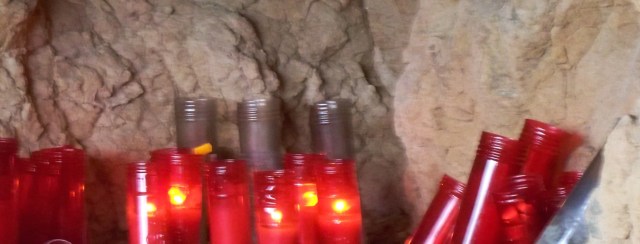
A huge feast was held that evening. The villagers partied below a rising full moon. Candles burned in red glass. They ate well and drank plenty, singing and laughing with a mixture of the relief of merriment and a loving sadness for little Lysl and her father.
Dawn approached. The villagers noted a yellow glow appearing in the west, not the east, where the sun should have been rising. Sarah, her friends, and Peyton Garcia the third, turned wide-eyed, to see Lysl and her father descending from the mountain.
Laughing and skipping, Lysl waved an armful of psychedelic flags in every shade of the rainbow. Steven walked beside her, a radiant guitar slung over his shoulder with a strap of gold and silver.
He strummed that ancestral tune with such enthusiasm that all sleeping butterflies in the honeysuckle awoke and took flight. Everyone on the playa was soon covered with a fragrance of honeysuckle that tasted like honey from the bees.
The reunion began in earnest.
And that’s the way it was.
Post Script: My answer to Brooklyn. The moral of the story is that no matter what happens in your family, or your village, if you all stick together with hope and faith, you can accomplish anything.
* *What a Wonderful World, by George David Weiss and Bob Thiele.
No Means Everything, Part 4
Last few sentences of Part 3:
One late summer afternoon, Alan was getting ready for work. He started yet another argument with Iris, yelling at her, fussing and fighting over some bill or another. It was money that usually set him off.
This time was different, though.
This time, he hauled off and shoved Iris to the kitchen floor. He kicked her in the ribs. He glared at her, hatred in his eyes as she lay there crying, her hands thrust in front of her.
“Shut up!” he screamed.
He dropped to his knees, his right arm raised to strike Iris, just as 2-year old Teddy, came scampering in. He looked down at his mommy, thinking, perhaps, that Mommy and Daddy were playing, because Iris saw his little face giggle with delight.
She was terrified, horrified. Alan glared at his boy, and jumped to his feet. He marched to the front door, throwing it open with so much force the doorknob smashed into the wall. The neighbors had to wonder at the screeching of the tires as he sped off in his fancy Mustang. Not one of them came to see if Iris and the boys were okay.
Iris reached her hand out to Teddy, asking him to go play with Ricky, in the playroom. Stabbing pain screamed at her. She raised herself up sluggishly. She walked across the room to the bay window, where she could watch the palm tree swaying in the breeze, a warm sunbeam flashing in her face. She sobbed. She was shaking. She was thinking.
Decision made, Iris turned from the window to pick up the phone. Trembling, her fingers repeatedly slipped off the dial. She reached her friend on the third try, crying and stumbling over her words.
“I need to move out. Now.”
They talked a few more minutes, Iris confessing what had taken place. Inside an hour, her friend showed up with a rented moving truck, a stack of packing boxes, and two big guys to help.
With an ace bandage wrapped round her ribs to minimize her pain, Iris and her friends dashed from room to room, packing the few things she really needed for now. After Ricky and Teddy’s initial confusion, they soon got carried away with Mommy’s new game of packing toys and trucks and books into their own boxes.
Iris got back on the phone to inquire into apartments for rent listed in the local paper. As soon as she landed one, they pulled out of the driveway, to a new life, on the far side of town.
She knelt down to the floor before walking out, holding her two boys closely.
“It’s right by the river, you’ll see,” Iris told them “you can come see Daddy here later. It will be like having two houses.”
She left a short note to Alan on her piano that she left behind that day.
Alan, I won’t stay in this house with you any longer. I’ll call you. Don’t try to find us. You’ll see the boys – later. Please, leave us alone for now. Iris
Several weeks later, an old friend stopped by to see how she and the boys were managing. They sat on the front porch watching the boys play with their new puppy. Iris had found a job, a friend to watch the kids while she was at work, and no, she was NOT going back to Alan. Yes, she’d already filed for divorce. As far as Iris was concerned, Alan could have everything, even the house. She didn’t care about any of it. She and her boys were safe. That’s all she cared about.
Later that year, sitting on the cold wooden courtroom bench, Iris listened as her front porch sentiments echoed back to her from her old friend in the witness chair. She shook her head, baffled as this so-called friend testified on Alan’s behalf.
The court awarded full custody of the boys to Iris, with visiting rights to Alan. Alan got the house, not a penny’s share to Iris. No child support order. No order for alimony.
Walking alone out of the courthouse, Iris felt a huge weight lifted from her. She was free.
She rushed home, grabbed up her little boys, loaded them into the car, and went straight to the beach. The sand, the sea air, the cold waves, the laughter – filled their day.
Little did they know the many wonders in store for them.

 Writer Paints